Friday, February 19, 2016

American Public Understanding and Opinion on Climate Change

Climate change is a controversial topic nowadays and one of the main worries at an international level, so to further investigate this topic we jumped on the streets of Philadelphia (PA, USA) and asked people questions on climate change to investigate American public understand and opinion on this topic. Here are the results:


Question 1:
How informed are you on the topic of Climate Change? (1= not informed, 5= a lot)


Question 2:
How important/relevant is the climate change as a global issue? (1=not important/irrelevant, 5= very important/crucial)


Question 3:
How much of a responsibility does the government have when it comes to solving Climate Change?


Question 4:
How much of a responsibility does the individual/s has when it comes to solving Climate Change?


Question 5:
How well do you think the (USA/Spain) government is doing when it comes to addressing the problems?


Question 6:
Do you trust your government to fulfil the promises they addressed in the international treaties for solving climate change?

Question 7:
How actively involved are you in reducing climate change?


Question #8:
What are measures or things individuals like you  or other people can do to reduce climate change?
  • recycle, compost, save energy, use environmentally friendly cars
  • recycle, quit smoking, walk, bike instead of driving, solar panels
  • carpool, recycle, public transportation, don't leave lights on
  • reuse water bottles/bags
  • reduce use of electricity, stop deforestation, ration resources, stop wasting food/resources
  • drive less, use less fossil fuels
  • take public transportation instead, walk and bike, recycle, do not litter
  • ride bikes, carpool, recycle, use less water, reduce use of electricity, put things on low power
  • Small action-wise are to recycle, manage your usage of electronics, use recyclable water bottles, and etc. In a larger sense, one can supportive and be knowledgeable of policies and programs that are available to encourage energy efficiency and sustainability.


Question/Tally
1
2
3
4
5
Question #1

✔✔✔
✔✔✔✔
✔✔✔
✔✔
Question #2

✔✔✔✔
✔✔✔✔✔
Question #3


✔✔✔✔
✔✔✔✔✔
✔✔✔✔
Question #4


✔✔✔
✔✔
✔✔✔✔✔✔✔✔
Question #5
✔✔
✔✔✔✔✔
✔✔✔✔✔✔


Question #6
✔✔✔✔
✔✔✔✔✔
✔✔
✔✔

Question #7
✔✔
✔✔✔✔✔✔
✔✔✔

Thursday, February 18, 2016

TED Talks about Climate Change.

Gavin Schmidt on "The emergent patterns of climate change"


James Hansen on "Why I must speak out about climate change"


  Al Goreon "Averting the climate crisis"


Spanish Public Understanding and Opinion on Climate Change

Climate change is a controversial topic nowadays and one of the main worries at an international level, we jumped on the streets of Seville (Andalusia, Spain) and asked people questions on climate change to investigate Spanish public understand and opinion on this topic. Here are the results:

Question 1:
In a scale of 1 to 5, how informed are you on the topic of Climate Change? In which 1 means uninformed and 5 means advanced knowledge.


Question 2:
In a scale of 1 to 5, how important/relevant is the climate change as a global issue? In which 1 means irrelevant and 5 means very important.


Question 3:
 In a scale of 1 to 5, how much of a responsibility does the government have when it comes to solving Climate Change? In which 1 means no responsability and 5 means greatly responsible.


Question 4:
In a scale of 1 to 5, how much of a responsibility does the individual/s has when it comes to solving Climate Change?In which 1 means no responsability and 5 means greatly responsible.


Question 5:
In a scale of 1 to 5, how well do you think the (USA/Spain) government is doing when it comes to addressing the problems? In which means a really badly and 5 means really good.


Question 6:
In a scale of 1 to 5, do you trust your government to fulfil the promises they addressed in the international treaties? In which 1 means no trust and 5 means completely trustful.


Question 7:
In a scale of 1 to 5, are you implicated with the  reduction of climate change? In which 1 means not implicated and 5 means really involved.


 According to the data recollected the following conclusions can be obtained:

-The first question consisted on asking people how much they know about the topic, most people answered either 5 or 3 which means, that on average, they were really informed on the topic, that's positive in the sense that they will provide quality answers.

-Everyone agreed on how this is an important topic at a worldwide level (Q2) and that both the individuals and the government (Q3 & Q4) are responsible for dealing with it and that we should all act in favour of the reduction of climate change. However, most people don't agree in the way the goverment is dealing with the problem (Q5). Also, even if on average, some people were hopeful, most people don't believe they will keep their promises and start fulfilling the treaties and promises signed in the international treaties (Q6).

-We could consider the response to the final question relatively positive since, on average, they were involved and implicated themselves, but compared to how important they think the climate change is, this is a low amount of implication. It means that everyone consider it a important problem but that not everyone is willing to actively contribute to reduce it.

Wednesday, February 17, 2016

Spanish solar panel law


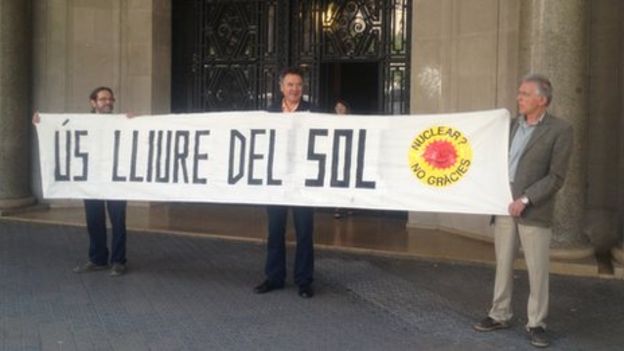
"We will be the only country in the world charging for the use of the sun," says Jaume Serrasolses.

Mr Serrasolses, the secretary of an association promoting the use of solar energy, SEBA, is referring to the Spanish government’s proposal for a tax solely on those who generate their own electricity.
They would pay a backup toll for the power from their solar panels, in addition to the access toll paid by everyone who consumes electricity from the conventional grid.

Although the tolls vary, if you pay an access toll of 0.053 euros per kWh, you could face a backup toll of 0.068 euros per kWh. The new tax would extend the average time it would take for solar panels to pay for themselves from eight to 25 years, according to the solar lobby.
The government says that with increasing "self-consumption", the income for conventional energy systems will decrease, but grid maintenance will cost the same.

Industry Minister Jose Manuel Soria accepts the measures are painful but says they are needed to plug the energy deficit.

"I support 'autoconsumo' ... but the power system has infrastructure, grids that the rest of us Spaniards who are in the system have to pay for. And we pay for it through our electricity bill," said Soria.

The government is hoping the energy reform will settle a debt of 26bn euros (£22bn; $35bn), which has built up over years as a result of regulating energy costs and prices.

A banner in Catalan reads: "Free use of the sun. Nuclear? No, thank you"

Nobody is going to make significant investment if it takes over 20 years to pay it off
Jaume Serrasolses, SEBA

Opposition groups say the law goes against European directives on renewables adoption and energy efficiency, while protecting the interests of utilities with strong influence over the government.
The way it’s made out, the royal decree safeguards the classic models of energy consumption when what is needed is to help to transform them urgently,” said Cecot, an industry body representing small and medium-sized businesses in Catalonia.

Other regional governments opposed to the law include the Junta de Extremadura in the southwest of the country, where infrastructure and economy minister José Luis Navarro criticized the PP’s “systematic policy of harassment and demolition toward renewable energy in Spain.” There has also been widespread media condemnation of the law, which was harshly criticized while still in draft form. “The energy self-consumption law weighs Spain down against the rest of developed countries,” said 20 Minutos. “Some measures have been softened, but it still imposes charges on consumers,” noted El Confidencial.

More recently, the government and the utilities are attempting to shore up support for the self-consumption law, while also trying to improve their green credentials. The utility trade body Unesa, for example, is thought to be behind a leaked Boston Consulting Group report warning that Spanish electricity bills could rise by 6 percent upon a 10 percent penetration rate of self-consumption. And José Bogas, chief executive of the Enel-owned utility Endesa, came out in defense of self-consumption but praised the current regulation in a widely reported speech at Esade, an international business school.

Meanwhile, the government, whose policies in the current legislation have led to the loss of around 65,000 renewable-energy sector jobs, has announced measures to support growth of Spain’s stricken wind industry. Contention over the self-consumption law is unlikely to die down before the end of the year. Those calling for an end to the law may not have to wait for long. 


Links:

Spanish government and climate change


What “PP” (actual government, right).

“Through this legislature, the involvement of PP with climate change has been evident”
1.-  CO2 Emission reduction, avoiding buying emission rights.
2.- Following the international agreements, commitment with Kyoto’s protocol.
3.-  Encouraging of CO2 emission reduction in “sectores difusos” (houses, services, agriculture, transports…)
4.- The Hoja de Ruta de Difusos para el 2020. has been elaborated.
5.- The Registro de la Huella de Carbono. has been created and implemented.
6.-  The Fondo Nacional de Eficiencia Energética. has been created and implemented. (energetic efficiency)
7.- They have improved the energetic interconnections with Europe.
8.-  The plan Plan PIMA Adapta has been created for the adaptation to climate change.
9.- Creation of Grupo de Crecimiento Verde de Empresas. (objectives: improve the synergy between the business sector and the administration against climate change)
10.- Awareness campaign “un millón de compromisos”.

Links:
http://www.transicionenergeticaycc.org/web/es/europa/que-hace-europa/sectores-difusos/

Monday, February 15, 2016

Public Opinion of Climate Change in the United States

by Nhi Lieu

This graph shows the overall percentage of these regions that are concerned about Climate Change

Scientific Opinion on Climate Change

Six in 10 Say Most Scientists Believe Global Warming is Happening

  • The scientific consensus is that the Earth's climate system is unequivocally warming, and that it is extremely likely (meaning, of at least 95% probability or higher) that humans are causing most of it through activities that increase concentrations of greenhouse gases in the atmosphere, such as deforestation and burning fossil fuels.
    • Warming of the climate system is unequivocal, as evidenced by increases in global average air and ocean temperatures, the widespread melting of snow and ice, and rising global average sea level.
    • Most of the global warming since the mid-20th century is very likely due to human activities.
    • Benefits and costs of climate change for [human] society will vary widely by location and scale. Some of the effects in temperate and polar regions will be positive and others elsewhere will be negative. Overall, net effects are more likely to be strongly negative with larger or more rapid warming.
    • The range of published evidence indicates that the net damage costs of climate change are likely to be significant and to increase over time.
    • The resilience of many ecosystems is likely to be exceeded this century by an unprecedented combination of climate change, associated disturbances (e.g. flooding, drought, wildfire, insects, ocean acidification) and other global change drivers (e.g. land-use change, pollution, fragmentation of natural systems, over-exploitation of resources).


Economic Opinion on Climate Change

  • for most economic sectors, the impacts of climate change would be smaller than the impacts of population and technology change.
    • For most people, what matters are not the global economic impacts, but the effects on the places they live and work.
  • this is not surprising given that the distribution of funding for climate change research is lopsided, favoring physical science rather than social science. The National Science Foundation's Social and Behavioral Science program is the primary source of federally funded basic research in the social sciences, and its whole budget for all social science—not just climate—is one-tenth of the U.S. Global Change Program, which was $2.6 billion in 2013.
  • climate change, which will result in more severe storms, will have a huge and varied global economic impact, and that the impacts will hit locally and ripple out by affecting supply chains, consumer behaviors, regional economies, and downstream jobs.


Media Coverage on Climate Change

  • media coverage of an issue can “play an important part in shaping political reality
    • Research into media coverage of climate change has demonstrated the significant role of the media in determining climate policy formation.
      • Public support of climate change research ultimately decides whether or not funding for the research is made available to scientists and institutions.
    • The media has considerable bearing on public opinion, and the way in which issues are reported, or framed, establishes a particular discourse


Political Opinion on Climate Change


  • Democrats typically more worried than Republicans about global warming and its potentially harmful effects on the environment. 
    • Democrats are most likely to say the seriousness of global warming is generally underestimated in the news, with about half (49%) saying so.
    • Another 32% of Democrats believe reports about global warming are generally correct. 
    • Less than one-fifth (18%) find that the seriousness of global warming is generally exaggerated.
  • Nearly seven in 10 of Republicans (68%) agree that the threat is generally exaggerated, while 15% say it is generally correct and 15% say it is generally underestimated.


Donald Trump On Climate Change: 'I Believe It Goes Up And It Goes Down'
"So I am not a believer, and I will, unless somebody can prove something to me, I believe there’s weather."

The Public Understanding on the Topic of Climate Change in the United States

The Public Understanding on the Topic of Climate Change in the United States
Chau Giang


Overview: Discussing the public understanding of Climate Change. Recent researches and polls have shown the understanding of Climate Change has changed from 1997 to 201. The people of the United States still have a difficult time accepting Climate Change is occurring even with the abundant of scientific evidence.


The American Public’s Understanding of Climate Change
  • According to American Psychologist, a time series of public opinion polls in the United States shows the changes of the public understanding from 1997 to 2010. Screen Shot 2016-02-15 at 4.17.21 PM.png
    • The polls consisted of three statements: Global warming is
      • is beginning or has begun
      • is due to more human activities than natural causes
      • will pose a serious threat to them or their way of life in their lifetime
  • Gallup polls taken in 2007 and 2008 show that 49% of the American public endorse the idea of Climate Change. The percentage is only half of the country compared to countries like Japan, which in the same polls resulted in 91%, or Argentina of 81%.
  • From gallup polls, it shows a significant and noticeable different in Climate Change depending on the political party an individual is in.
  • According to a poll of 1,058 people, the American public acknowledge that Climate Change is happening but less than one out of 4 people are extremely concerned about it
    Screen Shot 2016-02-15 at 7.02.26 PM.png
Difficulty accepting Climate Change is happening now and right in front of our eyes
  • Most scientists or specialist on the topic of Climate Change agree with Climate Change is happening now and something needs to change but to a non-scientist, it is more difficult and it can create misunderstanding of what Climate Change is.
    • For scientists, they have a wider understanding of what Climate Change is because of their science background. Scientist are able to understand the research behind the evidences of Climate Change but to an individual who does not have a strong science background, being told about the research will not be a great help. Those individuals will not understand all the information being put out and possibly only pick up what they can understand, which then can lead to misconceptions.
  • Climate Change is a hard topic to understand to some because it is invisible. It is easy to say it is not happening.
  • Climate Change is currently not directly affecting the public and the topic of Climate Change has yet to boil up to a point where the public wants to put it as top priority.


Misconceptions

  • "Scientists disagree about whether humans are causing the Earth's climate to change."
  • "Lots of things can impact climate—so there's no reason we should single out CO2 to worry about."
  • "Climate naturally varies over time, so any change we're seeing now is just part of a natural cycle."
  • "The hole in the ozone layer causes global warming."
  • "There is nothing we can do about climate change. It's already too late."
  • "Antarctica's ice sheets are growing, so it must not be true that global warming is causing glaciers and sea ice to melt."
  • " Global warming is a good thing, because it will rid us of frigid winters and make plants grow more quickly."
  • "The warming scientists are recording is just the effect of cities trapping heat, rather than anything to do with greenhouse gases."
  • "Global warming is the result of a meteor that crashed in Siberia in the early 20th century."
  • " Temperatures in some areas aren't increasing, so global warming is a myth."


Links
http://sciencepolicy.colorado.edu/students/envs_4800/weber_2011.pdf
http://climate.nasa.gov/evidence/
http://www.cbsnews.com/news/poll-most-americans-understand-arent-too-worried-about-climate-change/
http://www.prevention.com/health/healthy-living/10-global-warming-misconceptions