"We will be the only country in the world
charging for the use of the sun," says Jaume Serrasolses.
Mr Serrasolses, the secretary of an association promoting
the use of solar energy, SEBA, is referring to the Spanish government’s
proposal for a tax solely on those who generate their own electricity.
They would pay a backup toll for the power from their solar
panels, in addition to the access toll paid by everyone who consumes
electricity from the conventional grid.
Although the tolls vary, if you pay an access toll of 0.053
euros per kWh, you could face a backup toll of 0.068 euros per kWh. The new tax
would extend the average time it would take for solar panels to pay for
themselves from eight to 25 years, according to the solar lobby.
The government says that with increasing
"self-consumption", the income for conventional energy systems will
decrease, but grid maintenance will cost the same.
Industry Minister Jose Manuel Soria accepts the measures are
painful but says they are needed to plug the energy deficit.
"I support 'autoconsumo' ... but the power
system has infrastructure, grids that the rest of us Spaniards who are in the
system have to pay for. And we pay for it through our electricity bill," said Soria.
The government is hoping the energy reform will settle a
debt of 26bn euros (£22bn; $35bn), which has built up over years as a result of
regulating energy costs and prices.
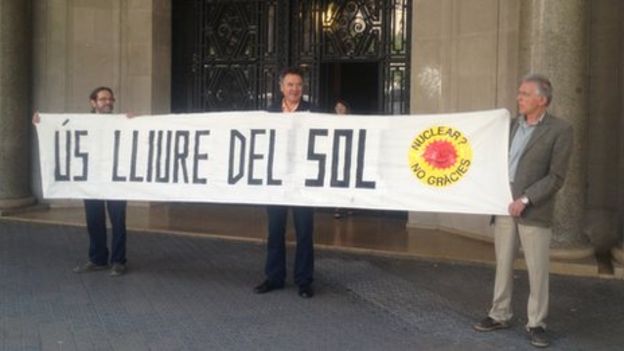
A banner in Catalan reads: "Free use of the sun. Nuclear? No, thank
you"
Nobody is going to make significant investment if it
takes over 20 years to pay it off
Jaume Serrasolses, SEBA
Opposition
groups say the law goes against European directives on renewables adoption and
energy efficiency, while protecting the interests of utilities with strong
influence over the government.
“The way it’s made out, the royal decree
safeguards the classic models of energy consumption when what is needed is to
help to transform them urgently,” said Cecot, an industry body representing
small and medium-sized businesses in Catalonia.
Other
regional governments opposed to the law include the Junta de Extremadura in the
southwest of the country, where infrastructure and economy minister José Luis
Navarro criticized the PP’s “systematic
policy of harassment and demolition toward renewable energy in Spain.”
There has also been widespread media condemnation of the law, which was harshly
criticized while still in draft form. “The
energy self-consumption law weighs Spain down against the rest of developed
countries,” said 20 Minutos. “Some
measures have been softened, but it still imposes charges on consumers,”
noted El Confidencial.
More
recently, the government and the utilities are attempting to shore up support
for the self-consumption law, while also trying to improve their green
credentials. The utility trade body Unesa, for example, is thought to be behind
a leaked Boston Consulting Group report warning that Spanish electricity bills
could rise by 6 percent upon a 10 percent penetration rate of self-consumption.
And José Bogas, chief executive of the Enel-owned utility Endesa, came out in
defense of self-consumption but praised the current regulation in a widely
reported speech at Esade, an international business school.
Meanwhile,
the government, whose policies in the current legislation have led to the loss
of around 65,000 renewable-energy sector jobs, has announced measures to
support growth of Spain’s stricken wind industry. Contention over the
self-consumption law is unlikely to die down before the end of the year. Those
calling for an end to the law may not have to wait for long.
Links:

Its really learning about climate change in another part of the world. I personally enjoy reading and discussing this topic.
ReplyDeleteReally like this topic, you did an awesome work, congrats!
ReplyDeleteGood work! I didn´t know that about our country, really interesting.
ReplyDeleteI love this topic. I also like reading about how Spain is dealing with climate change. It really opened up my eyes to see climate change as a problem on a global scale. The background picture suites the topic too. Overall, great work!
ReplyDelete